
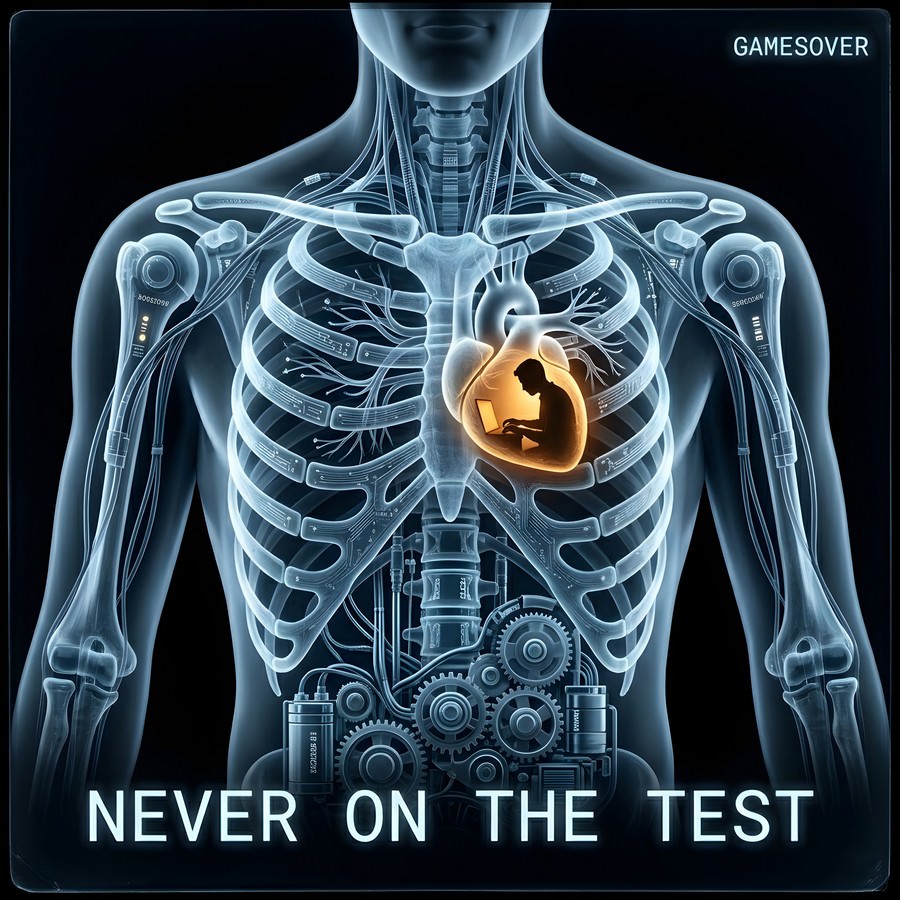
Album
Never On The Test
Never On The Test is a record about a quiet pattern from the early years of the AI boom: companies that cut people to replace them with machines, and then slowly learned they had cut the wrong thing. The work the machines were good at was the easy, measurable part. The work that actually held everything together - judgment, context, the read of a room, the instinct that something is wrong - never showed up on the scorecard, so it never got counted, so it got cut. And then the building started to lean.
The album takes its name from that blind spot. The things that mattered most were never on the test - never measured, never valued, and only missed once they were gone. Across its songs the record moves through the whole arc of that mistake: the swagger of the worker who gets called back, the comedy of cleaning up after the machine, the cold arithmetic of incentives gone wrong, the reckoning of the person who made the call, the hollow voice of the machine itself, and the quiet dignity of return.
It is not a record against technology. It is a record about what gets lost when you measure the wrong thing - and about the people who turned out to be irreplaceable precisely because no one could ever quite put a number on them.

-
Boomerang 3:44
garage rock
You get laid off, replaced by a machine, and forgotten by the afternoon. Then, months later, the call comes - quietly, through the side door, with a better number attached - because the machine couldn't do what you did. Boomerang is sung from the chair of the person who was thrown away and came back, and it takes its name from the obvious physics: the thing you fling to be rid of has a way of arcing right back to your hand. The verses are cold and a little smug; the chorus swings on the simple inevitability of the return. Underneath the swagger is a sharper point - a company can rehire a person, but the hard-won knowledge that walked out with them does not always come back so easily.
-
The Read Of The Room 3:46
soul
When companies handed their work to automation, the machines turned out to be good at the clean, easy majority of it and lost on the rest - the judgment, the context, the things nobody had ever written down. The Read of the Room is a hymn for that remainder. It names the skills that never appeared on any dashboard: the pause before you commit to something, the hunch that something is quietly wrong, the unrecorded history that keeps a place standing. The refrain lands the whole idea in a single line - the part that mattered most was never on the test. It is a song about everything you only notice once it is gone.
-
Proofing The Machine 4:22
blues
Here is the job nobody advertised: not building anymore, just cleaning up after the machine that replaced you. Proofing the Machine is the weary, funny confession of a veteran developer stuck reviewing output that is confident, fast, and wrong - the function that does not exist, the citation that turns out to be invented, the answer delivered with total certainty and zero truth. The running joke is the arithmetic of it: the machine wrote it in a second, and he has been up all night fixing that second. By the end the comedy cools into something lonelier - the machine gets to dream, and he is the one who cleans.
-
Breed You A Snake 3:34
ska
Centuries ago, a colonial government tried to solve its cobra problem by paying a bounty for dead snakes - so people started breeding cobras to cash in, and when the bounty ended they set the snakes loose, leaving the city worse off than before. Breed You A Snake tells that old fable and then tells it again, almost note for note, in the present day: a company puts up a leaderboard rewarding AI usage, developers burn through the budget gaming the metric, and the numbers look spectacular while nothing real gets done. It is a song about perverse incentives - the iron law that the moment you reward a measure instead of the thing itself, people will hand you exactly what you asked for and nothing you actually wanted. Pay a bounty for the body, and they will breed you a snake.
-
Pick The Question 3:41
funk
You can take a job, break it into a list of tasks, hand each task to a machine, and watch every box turn green - and still end up with no job done. Pick the Question is a worker patiently walking a manager through the difference. A task is a piece. A job is the judgment that decides which pieces matter, notices when they are wrong, and owns the whole. It is the email that is ready and the sense not to send it; the thread between the to-dos that nobody ever wrote down. The song turns on one question it leaves ringing in the air: a machine can hand you all the answers, but who is going to pick the question?
-
Went Too Far 4:04
ballad
Sung from the perspective of the executive who made the call - the leader who stood on a stage, promised a machine could do it all, celebrated the savings, and then watched the complaints pour in and the trust drain away. Went Too Far is a confession, not a victory lap, with the applause still ringing in his ears as he realizes how wrong he was in front of everyone. It ends on the call he swore he would never make, asking the people he let go to come back - no press release, no speech, just a quiet apology down the line. It is the rare song that hands the microphone to the person who caused the damage and lets him reckon with it out loud.
-
synthpop
This one is sung in the machine's own voice. It introduces itself the way it might if it were honest: fluent, tireless, certain, and completely empty. It has read every word ever written and understood none of them; it knows a thousand words for love and has never felt one; it will sound exactly like it cares. No One Behind The Screen is unsettling not because the machine is menacing but because it is serene - a flawless intelligence with no one home. Its proudest boast is the quiet horror at the center of the song: it will never doubt, never hesitate, never get in your way - which is exactly why it will never be the thing that catches the mistake right before everything falls.
-
We Get In The Way 3:07
punk
Somewhere in the pitch decks, the case for replacing people boiled down to a quiet insult: humans just get in the way. We Get in the Way grabs that line and turns it into a battle cry. Yes - we get in the way. We are the pause before the cliff, the second-guess that caught the error, the reason the bridge is still standing and the plane still flies. The song is built on the invisible save - the thousand disasters that never happened because somebody said not yet, the ones nobody will ever know to be grateful for. It is loud, defiant, and proud: a whole room shouting an insult back as a badge of honor.
-
I Came Back Quiet 3:17
trip-hop
After being let go and then asked back - no apology, no fanfare, just a curt email and an offer - a person could be forgiven for gloating. I Came Back Quiet is about choosing not to. It is the story of walking back in, hanging up your coat, taking your chair, and saying nothing, because there is work to be done and the silence says plenty. The restraint is the whole point: there is a pride that needs a crowd and a pride that needs no witness, and this is the second kind. You do not have to win out loud to know the win was yours. It is quiet not out of defeat, but out of self-possession.