Nothing New Under the Silicon
Ecclesiastes was composed about 2,300 years ago by a man who tried everything and found it all empty. If you read the first chapter while holding a phone in your other hand, the message seems very relevant. The sun rises and the sun sets. Rivers flow into the sea, but the sea never becomes full. The eye never feels satisfied with what it sees. There is nothing new under the sun.
This served as the main concept for this project. I swapped the word "sun" for "silicon" to see whether the original text stays applicable to contemporary subjects such as keynotes, upgrade cycles, and late-night scrolling. "Nothing New Under the Silicon" was launched on every streaming platform on May 25, 2026, and the video can be accessed now: https://youtu.be/pmtgRXwjdEY. There is a lyric version too, one word at a time, here: https://youtu.be/pV5ElK4Ynj0.
The words
I asked Grok to examine Ecclesiastes 1 verse by verse and connect each part to the technology industry. I then reviewed the points that appeared accurate. Generations pass, and each generation thinks it is the first to cause disruption. A creator receives no benefit once a hype cycle ends. When you acquire more information about how the industry works, including surveillance economics and the mathematics of attention, the work grows more difficult. This matches the end of the first chapter, which says that increasing your knowledge also increases your sorrow.
The lyrics keep the viewpoint of the Preacher. The first verse depicts a repetitive routine. The chorus translates the idea of "vanity of vanities" into modern data streams. The second verse centers on notifications and the habit of doomscrolling. In the bridge, the Preacher is shown as a man who examined every kind of value and decided it was all a pursuit of the wind. The outro is the part I consider most significant. It says that we do not remember the prominent figures we once praised. They lose their status and are forgotten within days.
I do not see the song as an argument against technology. My profession is writing software. The song acts as a reminder that while tools evolve, human nature stays the same. Anyone who claims the current era is unique has not read the source material.
The sound
Suno generated the music from a prompt describing melancholic indie folk with electronic elements. The directions called for acoustic guitar and piano placed under glitchy synthesizers and soft beats that fade like failing server connections. I used quiet Radiohead as my reference point. The chosen version includes a tired vocal quality that I liked immediately. The vocalist sounds as if they are performing at the end of a long day, which matches the song's mood.
The video
Every shot in the video depicts an item being replaced.
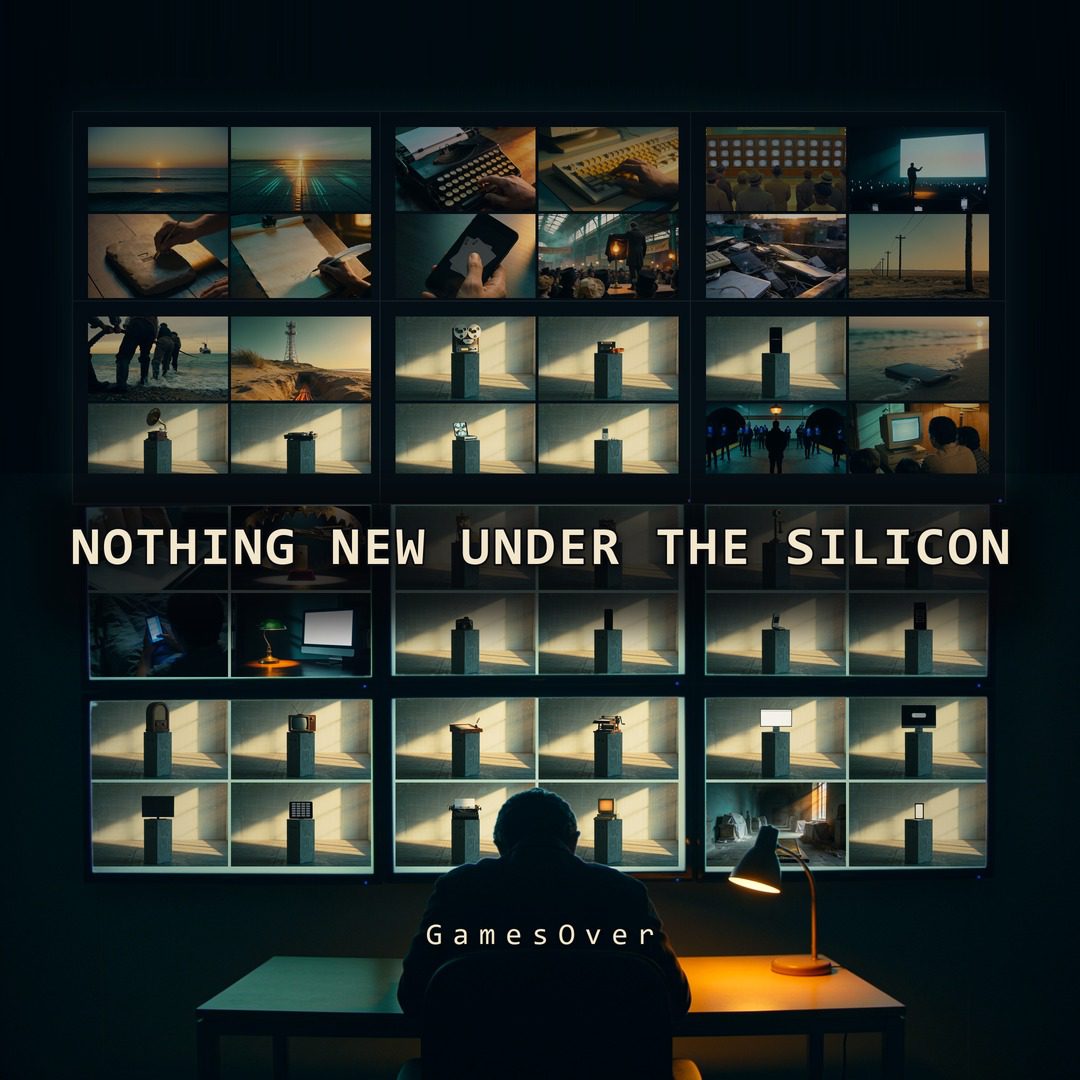
The primary set consists of a plain plaster room featuring a concrete pedestal illuminated by a beam of sunlight. An object rests on the pedestal. When the sun moves across the scene, the object disintegrates into dust. As the light passes, the next item in the series becomes visible. The list comprises a horn gramophone, a turntable, a reel-to-reel, a cassette, a CD player, an mp3 player, and a phone. Additional sequences display a bellows camera, a DSLR, and a phone; a candlestick telephone, a rotary phone, a flip phone, and a phone; and a wood-cased radio, a 1950s TV, a flat panel, and a tablet. Finally, a scribe's slope, a hand press, a typewriter, a beige computer, and a browser culminate in an AI answer box. The box transforms into vapor during the lyric "vapor in the breeze." The pedestal is left empty.
The list is based on research I compiled about inventions that faced opposition yet eventually replaced earlier technologies. These inventions include writing, which Socrates disliked, the printing press, the sewing machine, recorded music, talking movies, school calculators, and digital photography. Most of the items from that research appear in the video. The verses follow this literally. A hand holding a clay stylus, a hand holding a quill, a typewriter, a beige keyboard, and a thumb on glass appear in five cuts during the line "fingers never rest." Telegraph poles in the desert are replaced by a cable on the sand, followed by a cell tower on a dune. These are labeled 1861, 1866, and NOW. A crowd from 1882 watches an electric bulb, a 1954 crowd watches a wall of televisions, and a 2007 keynote crowd watches a phone on a stage. The faces remain the same, while the objects change.
No faces are directed toward the camera. The nearest example is the Preacher, who is shown from behind. He stands before six monitors that display a manuscript, code, a wall of numbers, busts of kings, and moving grass. The screens then turn off one at a time.
The video starts and finishes on the same horizon. A sunrise sea transforms into a silicon wafer. The wafer's grid reflects light like a field under the sun. This wafer image serves as the title image and thumbnail for both videos.
For the final line concerning giants, I initially placed fake names on the museum plaques. I believed that using real companies would give the line a commentary feel. When I reviewed the footage, the fake names proved ineffective. The purpose of the line is to show that these names were once familiar. I replaced them with real companies that appear around the frame: Kodak 2012, Nokia 2013, Blockbuster 2010, MySpace 2011, BlackBerry 2016, Palm 2010, Polaroid 2001, Netscape 2008, Compaq 2002, and Atari 1984. All of these companies were once regarded as the future.
How it was made, briefly
I selected 62 still images from OpenArt, with 56 of them appearing in the final version. I also added three short clips showing the sea, tide, and grass. All movement was created in the Fusion page of DaVinci Resolve, covering the sun band, dust, dissolves, transitions, the monitor wall, and the wafer at sunset. I applied one color grade to the whole project, using teal shadows and amber highlights to match the style of the previous GamesOver video. For the lyric version, I used Resolve's subtitle track burned into the image. The project contains 291 cues, each holding a single word. I timed them with a forced alignment of the vocal track to ensure the words did not appear later than the audio.
Claude Code locally automated most Fusion and Resolve tasks using the biult-in scripting interface. I reviewed the renders and gave feedback. The process took one full day. The song itself asks whether this production method is a positive development.