
Wyrdz: eleven songs about what words do
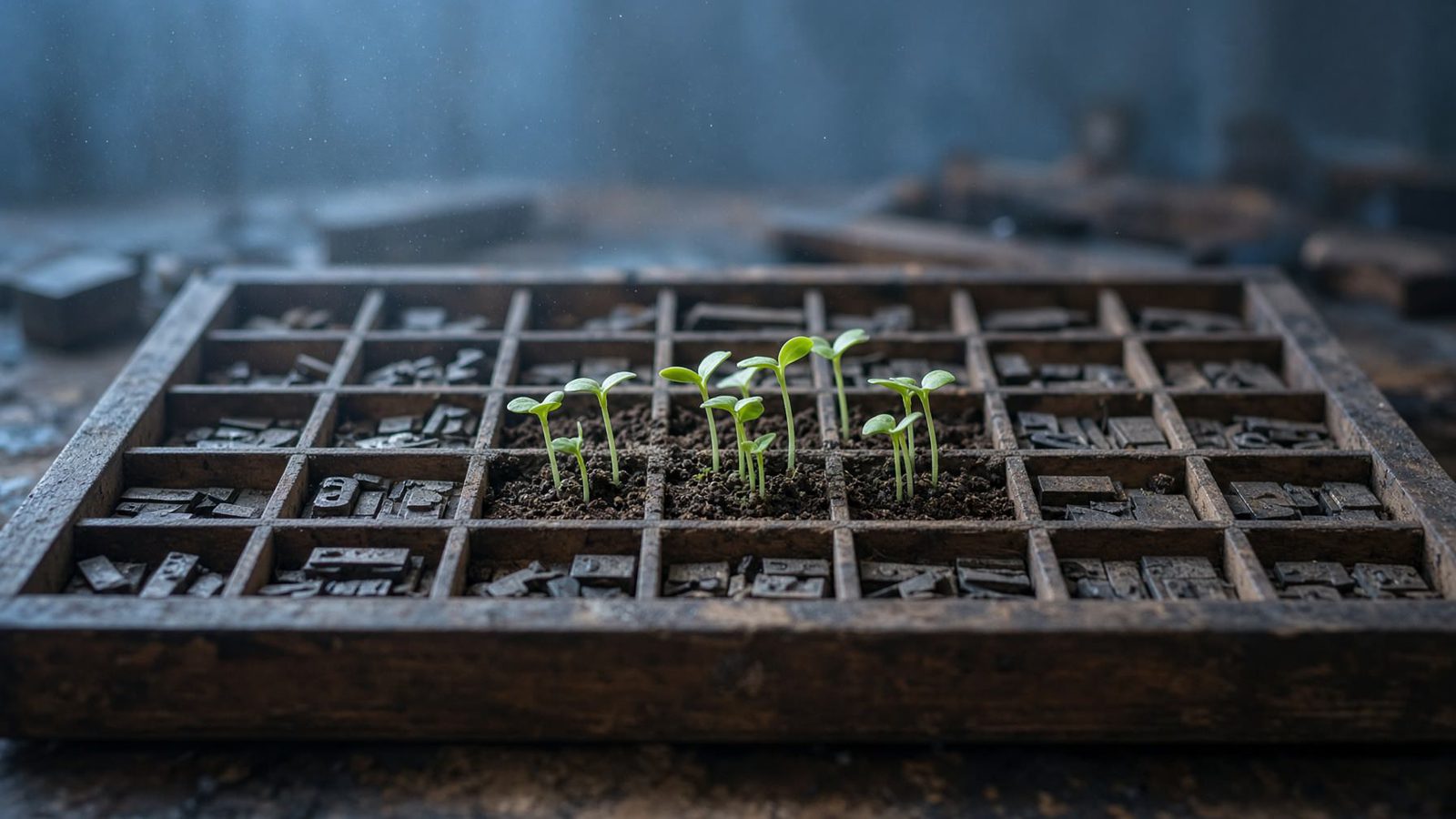
Released September 4, 2026. Album page: Wyrdz. Stream or buy: HyperFollow.
This album started as a series of dumb bets with myself.
Can you write a whole song in pig latin? (I wrote about that one already.) Can you sing lorem ipsum like you mean it? Can a man pronounce every silent letter in the dictionary and still keep the meter? Can the lyrics of a song be nothing but the names of the notes being sung?
Each one was a dare and I strove to turn each one into a viable song. After a few weeks, I had a folder full of word games and no idea what they had to do with each other.
Then I went looking into an old word, and found out what they had to do with each other.
The word
Wyrd is Old English. It usually gets translated as "fate," but that flattens it. The word is built on the verb weorthan/werþan, "to become," and its literal sense is closer to "that which comes to pass." The Romans filed destiny under speech: fatum means "the thing spoken," a sentence handed down. The Anglo-Saxons filed it under outcome. Wyrd is just what happened, and it has no speaker behind it.
It is also, by a long detour through Shakespeare's Weird Sisters, the ancestor of our word "weird." Every casual "that's weird" is a worn-down reference to the Fates. I find that funnier than I probably should.
What got me was setting wyrd next to Scripture. Hebrew has a word, dabar, that means both "word" and "thing," both the saying and the event. Genesis 1 says "And God said" ten times and nothing gets built. It gets said, and then it is. Isaiah 55:11 promises a word that goes out and does not return void. And in James 3:6, the phrase the King James renders as "the course of nature" is, in Greek, "the wheel of becoming." James says the tongue sets that wheel on fire. A turning and a becoming. Those are the exact two parts wyrd is made of.
One honest footnote, because this gets repeated wrong all over the internet: "word" and "wyrd" are not related. They come from different roots, one meaning "to speak" and one meaning "to turn." They ran one letter apart in Proto-Germanic and never touched. The connection I'm drawing is a theme. It is not an etymology.
That was the nature of the album. Spoken words become real events. My collection of novelty songs consisted of experiments rather than jokes. Each song tested the same concept. The structure of a word has an impact regardless of the speaker's intent. Gibberish sounds like heartbreak when it is sung with sincerity. Jargon remains an effective way to control a room. A listener hears a truth in a verbal mistake when they hear it a second time.
So I wrote a title track to say that out loud, spelled it with a Z because it is an old word in a new mouth, and put it first.
The challenges
Every song on the record has a rule it is not allowed to break.
- A pig latin song has to be real pig latin from the first line to the last, and in pig latin every word ends in "-ay," which makes rhyme both automatic and useless.
- Every verse of the pangram song, and its chorus, must contain all 26 letters. I checked them with a script. They do.
- The solfege song has 217 sung syllables, and each one has to name the pitch it is sung on. Every bar had to add up to exactly four beats. That got machine-verified too, against a MIDI file of the melody.
- The silent letter song had to be spelled phonetically ("re-seep-tuh," "plum-burr"), with the syllables counted on the wrong spellings, because those are what actually get sung.
- The spoonerism song has to read as a plausible, slightly off late-night poem before you notice that "chilled grease" is a grilled cheese.
- The palindrome song could not be a letter-by-letter palindrome, because those collapse into nonsense within a line or two. The structure had to carry it.
- The big-word song had to use every ten-dollar word correctly. A song that mocks a show-off with misused vocabulary is just a second show-off.
- The eleven-language song had to hold together for a listener who speaks one of them.
Then there was the second layer of difficulty, which is the instrument. GamesOver is human ideas and machine instruments. The lyrics were worked out with AI help (Grok on some, Claude on others) and the music is generated by Suno. Suno does not read sheet music, it guesses at pronunciation, and it will happily drop a word it does not like. Getting it to sing a wrong pronunciation on purpose, or switch languages four times in one verse, took a lot of respelling. Several of these songs exist mostly because I wanted to know whether it could be done at all.
And the last challenge was sequencing. Ten gimmicks and a sermon is a strange thing to put in order. I would perform initial research, open with the thesis, spend the next third playing with words, spend the final third feeling their weight, and close on a human being asking to be heard.
The songs
Eleven tracks, about 40 minutes.
1. Wyrdz. A boom bap Bibilical sermon on the power of the tongue. It begins with "And God said," introduces Adam naming the animals, highlights warnings in James 3 regarding a mouth nobody can tame, and ends with Isaiah's coal. As a modern day, self-identifying skald, I considered the word "wyrd" and its relevance to fate, but also in view of my faith. It serves as the opener so that everything after it reads as evidence.
2. Sesquipedalian Sam. Western swing about a barstool blowhard who never met a syllable he couldn't multiply. While every big word is used correctly, three small ones have the most profound meaning and effect.
3. Where Stories Dwell. A storybook song in which every verse is a pangram, set to progressive rock. It includes bronze foxes, quirky wizards, and a waxy jaguar with every verse and chorus accounting for all 26 letters. (A story-based music video has been created for this song.)
4. I Paid for Every Letter. Outlaw country from a man who bought a dictionary at full price and refuses to let one silent letter go unsung. He keeps the re-seep-tuh in a gold frame. This song is a lot of fun as I enjoy speaking silent letters out loud.
5. Note for Note. A doo-wop song whose lyrics are its own sheet music. Do, re, mi, and nothing else, each syllable naming the note it lands on. My family watched "Do-Re-Mi" from the movie "The Sound of Music" (1965) and I've never been able to get that song out of my head. This song is just as rememorable as there are only 8 words to the song.
6. Dolor Sit Amet. Lorem ipsum as a raw piano confessional. This is 180 seconds of placeholder Latin, sung with total conviction, and somehow it comes out sounding like grief. This came as a response song to my business partner who kept sharing songs in Italian that he was creating for his extended family in Sicily.
7. Boil the Ocean. A boardroom pitch as an electropop strut, sung by a man who means every buzzword. The bridge finds a fruit tree nobody picked. I don't often sit in any marketing meetings. when I do, I always ask for clarification when anyone attempts to use corporate jargon.
8. Alwaysway Isteninglay. "The government is always listening," entirely in pig latin. The last joke on the record, and the one that starts the listening thread that runs through the back half. (This song was the first single released and has a music video.)
9. Second Pass. Midnight kitchen, radio low... and a plate of chilled grease? A regret song where every odd image is a spoonerism, and the truth only comes clear on the second listen.
10. Back Again. A breakup song built as a mirror. The sections run forward to the bridge and then backward out again, and the man who thought he was walking away finds out he was only turning. I really like the chill vibe of this track.
11. Tell Me That You Hear Me. This song features one person singing in eleven different languages. The chorus concludes with a single sentence in plain English. The song represents the concept of Babel from an internal perspective and serves as a response to the first song on the album.
The cover
My family is Norwegian & Swedish on both sides. (I'm 66% & 18% respectively.) I wanted the artwork to honor that without runes or anything else that reads as pagan. I worked through illuminated manuscript letters, rosemaling borders, a live coal held in iron tongs, and a figure breathing fog over a winter fjord.
The chorus of the title track won instead. "Every word is a seed." The cover is five blocks of metal letterpress type sitting in dark, wet soil, spelling the title, with a pale green sprout coming up out of the "W".
The "Z" is used on purpose in an attempt to modernize it. Old word, new mouth.
What comes next
Each song gets its own write-up here: the rule it had to follow, how it got made, and what I think it is doing on the record. I'll link them below as they go up.
Two ideas run through the back half, if you want something to listen for. One is listening: "the government is always listening," "on the second pass I hear it clear," "tell me that you hear me," and the title track's warning that you will hear your own audio back. The other is small words beating big ones. Sam figures that out in a bridge. It took me eleven songs. I hope you enjoy listening to this album as much as I enjoyed making it.